[Published: Saturday October 31 2026]
 Israeli parties begin coalition talks as Netanyahu's party collect most votes but no clear winner emerges
By Tim Stickings
TEL AVIV, 31 Oct. - (ANA) - Israeli politicians have begun talks on forming a government after the country finished counting votes in its general election, confirming neither Prime Minister Benjamin Netanyahu nor his main rival Gadi Eisenkot has a clear path to power.
With all votes in, Mr Netanyahu's Likud was the largest party with 20.5 per cent of the vote – a better-than-expected result that gives Israel's longest-serving leader a shot at staying in power despite a host of controversies at home and abroad.
But the 53 seats won by Mr Netanyahu and his current right-wing coalition partners fell short of the 61 needed for a majority in the 120-member Knesset.
Mr Eisenkot's Yashar party came second with 16.1 with per cent of the vote. Parties seen as backers of the former army general had 48 seats between them, while Arab parties won the remaining 19 seats in a record performance.
The final day of counting was overshadowed by claims and counterclaims of interference in the election. Mr Netanyahu has alleged fraud and bribery involving Arab parties, who on Thursday rejected the “baseless allegations” and accused Likud of damaging the legitimacy of the vote. Qatar also spoke up to deny claims of involvement.
The indecisive result sets the stage for what could be weeks or months of negotiations to form a government. Israeli President Isaac Herzog has urged parties to avoid an early second election and enter talks with an “open mind”.
Three blocs
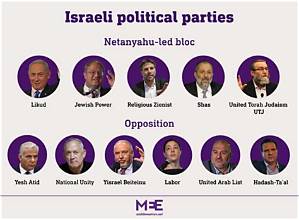
Of the 53 seats in Mr Netanyahu's camp, Likud had 27, while parties led by far-right ministers Itamar Ben-Gvir and Bezalel Smotrich won seven and six, respectively. Two Ultra-Orthodox parties took the rest.
The potential Eisenkot bloc has 48 seats, led by Yashar on 21. An alliance of former prime ministers Yair Lapid and Naftali Bennett won 12 seats. The anti-Netanyahu camp also includes the centre-left Democrats, with eight seats, and the Yisrael Bentenu party, on seven.
The Arab-led Joint List won 11 seats, with the Ra'am party winning eight.
There appeared to be no easy path to 61 seats. Leaders of the Arab parties have offered their support to an anti-Netanyahu government, potentially giving Mr Eisenkot a majority. But relying on Arab support would be hugely contentious in Israel and some members of the Eisenkot bloc had ruled it out during the campaign.
Another possibility would be for Mr Netanyahu to peel off members of the Eisenkot camp, some of whom are on the right of Israeli politics. However, all had campaigned on removing Mr Netanyahu, whose policies have been divisive at home and led to allegations of war crimes and genocide.
Talks begin
Speaking on Thursday, Mr Eisenkot promised to act “calmly and with determination” but gave no details of how he planned to form a government. He said he would not allow the swearing in of the new Knesset to be delayed “by a single centimetre” despite investigations into the vote.
As cross-party talks began, Mr Eisenkot met the leader of the centre-left Democrats, Yair Golan, who was also speaking to Mr Lapid and one of the Arab party leaders, Mansour Abbas.
“Israeli citizens fired Netanyahu,” Mr Golan said. “We will do everything to establish a government of change and rescue – because that is the will of the voter.”
While counting was completed on Thursday, the results are still to be finally ratified. Once they are, Mr Herzog can select a member of the Knesset to form a coalition. If neither Mr Netanyahu nor Mr Eisenkot can make it to 61 seats, another election is possible early next year.
Likud was calling for Israeli security services to investigate the fraud claims. Critics say that by stepping up attacks on Arab parties, Mr Netanyahu may be trying to ensure that Mr Eisenkot feels unable to form a minority government with Arab help that could remove him from power.
Turnout soared in Arab communities, with some voters who had previously boycotted Israeli elections taking part for the first time. Israeli broadcasters said it could have reached 80 per cent. But few would count out Mr Netanyahu, who has survived a long series of scandals and political crises to rule Israel for all but 18 months since 2009.
In the meantime, Mr Netanyahu remains in power and there are he will use the interlude to his advantage by launching new attacks on Iran. The US is also said to be considering new strikes after midterm elections next week. - (ANA) -
AB/ANA/31 October 2026 - - -
|