[Published: Wednesday November 11 2026]
 Gaza is being battered this winter amid Israel's ongoing genocide
ISRAELI OCCUPIED GAZA, 11 Nov. - (ANA) - In Gaza, even the rain that people once waited for has become something to fear. For Palestinian families who survived Israeli bombardment and repeated forved displacement, winter, because of years of the Israeli genocidal war, brings another form of disaster: flooded tents, collapsing sand embankments and freezing nights.
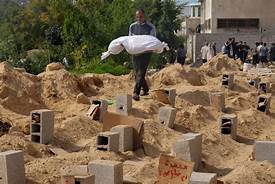
On Sunday, four children, a pregnant woman and a man were killed in Deir al-Balah city in central war-torn coastal enclave when a sand embankment collapsed onto their tents, turning their last refuge into a grave.
The victims—Salah Nabhan, Mariam Nabhan, Reem al-Zein, Ibrahim al-Zein, Habiba al-Zein and Tahrir Nabhan—belonged to two families from Jabalia in the north of Gaza. The collapse struck tents at the Ard al-Ribat shelter centre; others were injured.
Mohammed Abdel Hadi, a displaced resident of al-Baraka, was among those who rushed to the scene after hearing screams.
He told The New Arab that several people were trapped beneath the sand when he joined efforts to pull them out.
"The sight of children whose faces had turned blue was unbearable. We did everything we could to rescue them, but it was too late," he described. "What did these children and women do to deserve such an end? It is a scene we will never forget."
"Rain, usually a source of life, has become another cause of death […] Here, we face danger from bombardment, unstable embankments, buildings at risk of collapse and floodwater," he added.
Tents unable to withstand the rain
The collapse in Deir al-Balah was the deadliest incident since heavy rains began sweeping across the war-devastated coastal enclave on Saturday, flooding tens of thousands of displacement tents and leaving families struggling to protect themselves and what remained of their belongings.
Approximately 70,000 tents had been damaged within 12 hours, while dozens of walls collapsed and several people were injured. Initial material losses were estimated at US$3 million, according to Gaza's Government Media Office.
Beyond the official figures, the storm has left displaced families struggling to salvage their few remaining possessions and protect their makeshift shelters.
Salima Abu Sabha, displaced in Deir al-Balah, told TNA that her family had tried to prepare for the rainfall by digging channels and building barriers from wooden planks and iron bars to divert water away from their tents in a low-lying area.
However, the heavy downpour overwhelmed their preparations. Water entered several tents, soaking bedding and damaging their coverings. A supporting pole collapsed and the roof of one tent tore, leaving the family struggling to protect its remaining possessions.
"For the fourth winter in a row, we have been afraid of the rain. Our tents have deteriorated after months of displacement and exposure to harsh weather, and we cannot afford the materials needed to repair or replace them," she said.
Samah al-Masri, another displaced woman, told TNA that many families could neither afford new tents nor obtain the materials needed to protect their existing shelters.
"Even plastic sheeting requires supporting structures that many families do not have, while adding extra weight could cause already fragile tents to collapse," she said.
With their shelters damaged and alternatives out of reach, many families have nowhere dry to sleep and no means of moving to safer accommodation.
The flooding has exposed not only the vulnerability of Gaza's makeshift shelters but also the limited capacity of local authorities to protect hundreds of thousands of displaced people as winter sets in.
Hundreds of thousands left exposed
Raed al-Dahshan, director-general of Gaza's Civil Defence, told TNA that approximately 350,000 displaced people had been affected by the storm. Three homes had partially collapsed, while the roof of a fourth had caved in.
He warned that more than 2,000 buildings across the Strip were at risk of collapse, adding that restrictions on the entry of equipment into Gaza, alongside shortages of machinery and essential supplies, had severely hampered Civil Defence teams' ability to respond.
Gaza Municipality, meanwhile, received 251 reports and 84 urgent calls concerning flooding. Damaged drainage networks and shortages of water pumps and heavy equipment further complicated emergency operations.
Mayor Yahya al-Sarraj said there was nowhere to relocate displaced families, while humanitarian organisations remained "handcuffed" by restrictions that prevented them from providing an adequate response.
The scale of the shelter crisis was also highlighted by Social Development Minister Samah Hamad, who warned that thousands of families had lost their already inadequate accommodation and that children were at risk of dying from the cold, as only limited quantities of tents and other essential supplies were entering Gaza.
Ruqayya Abu al-Rub, a reconstruction official at the Ministry of Public Works and Housing, estimated that the Strip needed approximately 270,000 tents, as existing shelters continued to deteriorate and available supplies remained insufficient.
The Ministry of Social Development called for the entry of mobile homes and the provision of safe shelters, warning that the westward shift of the so-called yellow line had further reduced the space available to displaced Palestinians and intensified overcrowding.
Aid trapped in political calculations
With local authorities struggling to respond and hundreds of thousands of displaced people lacking adequate shelter, the crisis has exposed the failure of political and international efforts to secure humanitarian assistance on the scale needed.
The Palestinian presidency blamed Israel for the worsening conditions and called for border crossings to open to humanitarian aid, while criticising UN envoy Nickolay Mladenov for failing to ensure ceasefire commitments were honoured.
Seven Palestinian factions jointly demanded the entry of 600 trucks daily, including food, shelter and heating supplies, caravans and Civil Defence equipment.
Hamas separately accused Israel of obstructing the ceasefire's humanitarian protocol and criticised what it described as the "tepid" position of Mladenov's office.
The UN Office for the Coordination of Humanitarian Affairs warned that available stocks were insufficient for winter needs, citing funding shortages and restrictions on supplies. It called for winter assistance, heavy machinery and spare parts for humanitarian vehicles and generators.
While Israel bears primary responsibility for the blockade and restrictions on aid, Palestinian factions also bear responsibility for failing to develop a unified and effective strategy to secure essential supplies.
Their political divisions have further weakened efforts to address the humanitarian emergency, while international organisations have failed to deliver an adequate response.
Raed Nassar, a displaced resident of Deir al-Balah, told TNA that floodwater had entered his family's tent, destroying their bedding and leaving them without a dry place to sleep. Unable to repair or replace the shelter, he blamed Palestinian political divisions and the factions' failure to press effectively for basic necessities.
"People here do not need scattered statements or political posturing. They need shelter and protection for their children. We have lost our homes and are now losing our tents, yet no one is doing enough to save us," he said.
Gaza-based political analyst Mustafa Ibrahim told TNA that humanitarian assistance and reconstruction had become entangled in regional and international political calculations rather than being treated as urgent humanitarian priorities.
He said international pressure had been inadequate, while Palestinian divisions had weakened efforts to find practical solutions.
"Using aid as a bargaining chip leaves civilians, especially children and displaced families, paying the price. Their safety must not depend on political negotiations," Ibrahim said.
As rain continues, thousands of displaced families face another cold night without dry bedding or adequate shelter, turning winter into yet another struggle for survival. - (ANA) -
AB/ANA/11 November 2026 - - -
|