[Published: Friday November 20 2026]
 Gaza's farmers struggle to revive food production amid destruction and shortages by Israel
By Sally Ibrahim
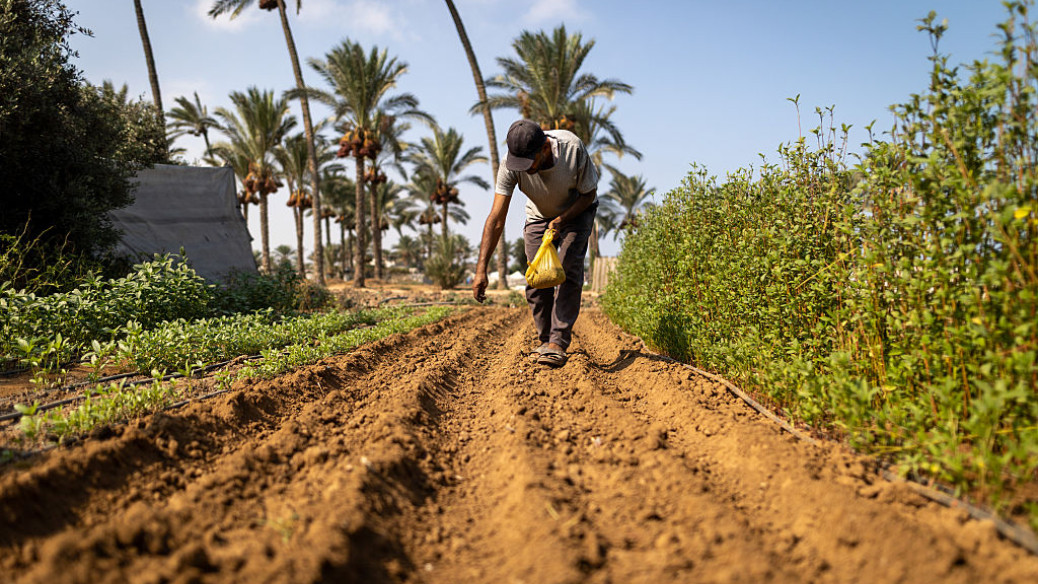
Israeli Occupied Gaza, 20 Nov. - (ANA) - In the town of Beit Lahia, in the northern war-torn Gaza Strip, Palestinian farmer Ziad Abu Khousa is trying to reclaim his land and revive his agricultural livelihood after much of his property was destroyed during Israel's genocidal war.
Despite extensive damage to his farmland, he has begun restoring parts of it and preparing greenhouses in the hope of resuming vegetable and some fruit production with whatever resources remain available.
"When I returned to my land, I found that almost everything had been destroyed," Abu Khousa told The New Arab. "The soil we used to cultivate requires enormous work to become suitable for farming again. But I could not abandon my land, so I decided to start over with whatever means I had."
He said he has begun reclaiming sections of the property and preparing greenhouses, although the shortage of agricultural supplies has made the process difficult.
"We want to resume production, even on a limited scale. We no longer have the resources we had before the war, but we are trying to make use of everything available to us," he added.
Beyond the destruction of land, farmers struggle to obtain essential supplies: greenhouse plastic, frames, seeds, fertilisers and irrigation equipment. Available local supplies often cost prohibitively much.
"Sometimes the land is ready for planting, but we cannot start because seeds, fertilisers or irrigation supplies are unavailable," Abu Khousa said. "We have to look for alternatives and buy what we need from the market, even though prices have become exorbitant. Every stage of farming now requires more effort and money."
For him, rebuilding his greenhouses is not simply about restoring a lost source of income. It is also an opportunity to contribute to local food production at a time when Gaza's residents are struggling with rising vegetable prices and dwindling supplies.
"We want to cultivate our land, eat what we produce and sell part of the harvest to provide for our families," he added. "All we ask is to be able to work our land and obtain the agricultural supplies we need. The land is there, and we want to cultivate it, but we need the resources to continue."
Local alternatives
With conventional agricultural tools increasingly difficult to obtain, farmers across Gaza have been forced to find alternative ways to sustain production, relying on locally available materials to reduce costs and improve soil fertility.
In Khan Younis, southern Gaza, farmer Mahmoud Al-Shaer has turned to organic waste and crop residues to produce fertiliser, attempting to maintain cultivation despite the shortage of conventional agricultural supplies.
"We are doing the impossible to keep food production going in Gaza," Al-Shaer told TNA. "We collect waste from poultry, sheep and cattle and use it to fertilise the land because conventional fertilisers and chemical inputs are no longer available as they were before."
His family also collects agricultural residues, including the stems and leaves of tomato and cucumber plants, shreds them and reuses them to prepare the soil for planting seedlings and vegetables.
He said practices previously used mainly to manage agricultural waste have become essential for farmers trying to overcome shortages of basic production materials.
Meanwhile, several displaced families have turned to small-scale cultivation to secure part of their daily food needs and reduce their dependence on increasingly expensive markets.
In al-Zawaida town, in central Gaza, Abu Raji Abu Armana and his wife have rented a small plot beside their tent, where they grow aubergines, tomatoes, chilli peppers and cucumbers for their family of six children.
The family does not regard the small garden as a commercial agricultural project, but rather as a means of obtaining fresh vegetables and reducing household expenses.
"Because of our displacement, we had to rent a small piece of land next to our tent to cultivate," Abu Raji told TNA. "We live on what we grow. If we manage to get three tomatoes in a day, we can make a salad. We might also pick one or two aubergines to prepare a meal."
His wife, Um Raji, and their young children help water and tend the plants, making cultivation part of their daily routine.
"My children and I leave the tent to work the land and water the plants. We then harvest vegetables to feed them and prepare their breakfast," she said. "We try to provide what we can, but prices are high and living conditions are difficult. Only God knows what we are going through."
However, the family's ability to continue cultivating the plot remains uncertain. Abu Raji says they live in constant fear of further displacement, particularly because of the proximity of the so-called Yellow Line, which marks an area of Israeli military deployment and restrictions.
Agricultural sector devastated by war
These individual efforts to restore food production are taking place against the backdrop of widespread destruction across Gaza's agricultural sector, affecting farmland, greenhouses, livestock facilities, fisheries and essential infrastructure.
Gaza-based agricultural expert Nabil Abu Shamala told TNA that the situation is a comprehensive agricultural catastrophe, saying that the destruction has affected nearly every component of the sector.
He estimated that the remaining cultivated land accounts for no more than 7 per cent of Gaza's total agricultural area. Restrictions on the entry of essential supplies, particularly fertilisers, pesticides and seeds, have also sharply increased production costs.
According to Abu Shamala, farming costs have increased by more than 1,000 per cent, driving up prices for agricultural produce and placing additional pressure on both farmers and consumers.
"The Gaza Strip is experiencing an agricultural catastrophe in every sense of the word following the destruction of the infrastructure underpinning the entire agricultural sector," he said.
Loay Rajab, director of public relations at Gaza's Ministry of Agriculture, told TNA that the damage to the agricultural sector has exceeded 85 per cent across most production areas, with direct and indirect losses estimated at approximately US$3.5 billion.
"Direct losses account for around US$1.9 billion, while indirect losses have reached approximately US$1.6 billion. This destruction has severely undermined the sector's productive capacity and threatened the livelihoods and food sources of thousands of families," he said.
"Crop production, which is a cornerstone of Gaza's food supply, has suffered damage affecting approximately 160,000 dunums of agricultural land, representing around 87 per cent of the total," he added.
Against this backdrop, restoring agricultural production requires more than emergency food assistance. It also means helping farmers regain their ability to cultivate land, generate income and supply local markets.
The United Nations Food and Agriculture Organisation (FAO) has provided conditional cash assistance to farmers able to access their land, enabling them to purchase essential supplies and resume cultivation.
In 2025, the organisation supported approximately 1,700 farmers, who cultivated around 4,250 dunums and produced more than 5,600 tonnes of fresh vegetables.
The initiative helped provide food for approximately 121,000 people and supported income generation for around 9,500 individuals, including farmers and their family members.
Such initiatives highlight the importance of reviving local agricultural production as Gaza's population continues to depend heavily on humanitarian assistance and struggles to afford increasingly expensive food.
For farmers such as Abu Khousa, however, returning to the land remains a difficult undertaking. Access to farmland, seeds, fertilisers, greenhouse materials and irrigation systems, alongside the ability to market their produce, will determine whether their individual efforts can develop into sustainable agricultural activity. - (ANA) -
AB/ANA/20 November 2026 - - -
|